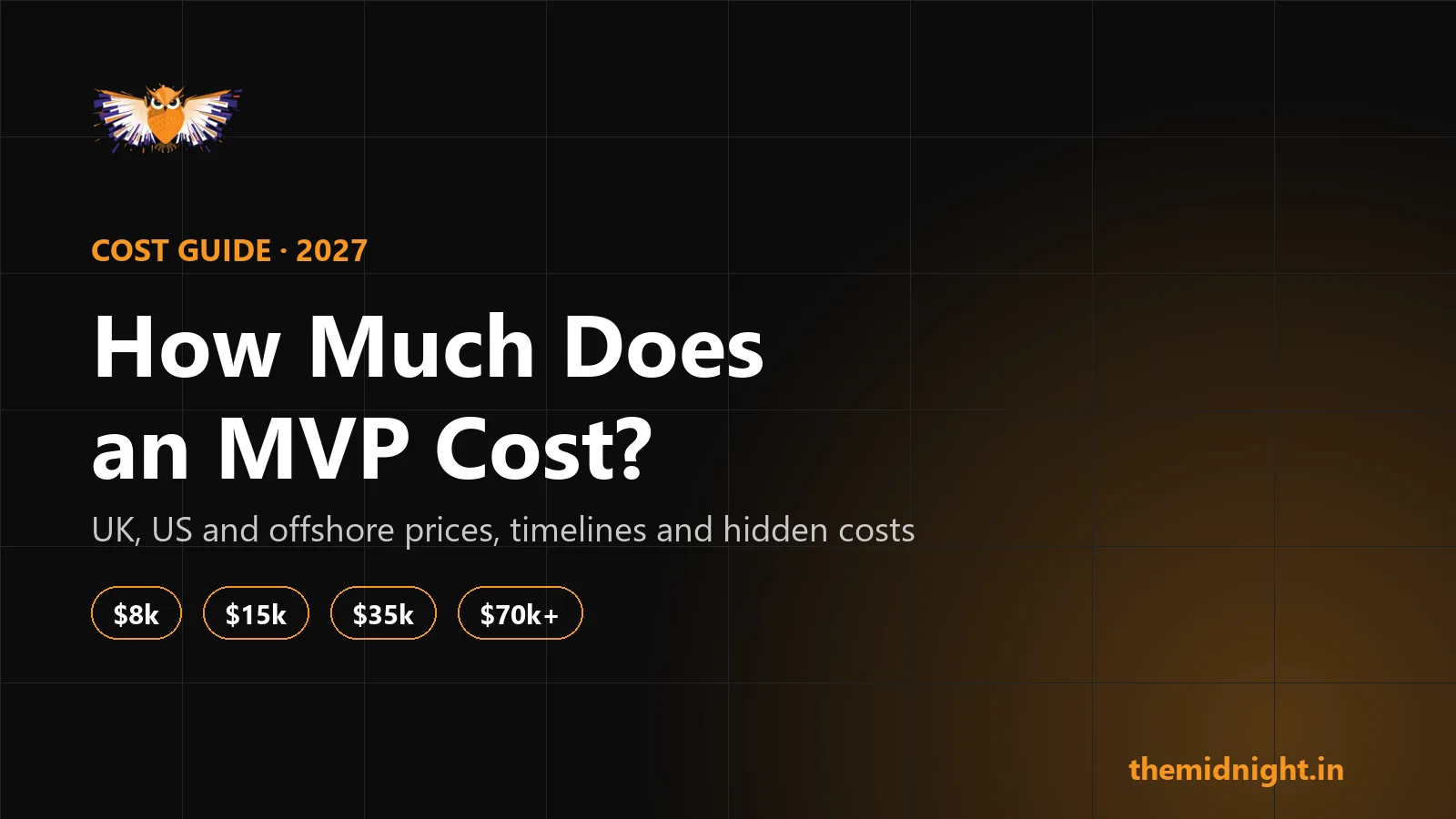
“How much will our MVP cost?” is the first question almost every founder asks us. The honest answer is a range, not a number, because an MVP can be a simple booking app or an AI-powered marketplace. This guide breaks down realistic budgets for 2027, what drives them, and how UK and US founders can build a solid MVP without overspending.
What is an MVP, really?
A minimum viable product is the smallest version of your product that real users can use and pay for, so you can test your idea before investing in the full build. A good MVP is small but complete: it does one job well, looks trustworthy, and gives you data on what users actually do.
If you are still shaping the idea, read our guide from idea to MVP first.
MVP cost ranges in 2027
These are typical ranges for an MVP built by an experienced offshore team in India. They include design, development, testing and launch.
| MVP type | Typical examples | Typical budget | Typical timeline |
|---|---|---|---|
| Simple | Booking app, directory, internal tool, landing page with accounts | $8,000 – $15,000 (£6,500 – £12,000) | 6–8 weeks |
| Medium | Marketplace, SaaS with subscriptions, app with payments and chat | $15,000 – $35,000 (£12,000 – £28,000) | 8–14 weeks |
| Complex | AI-powered product, real-time tracking, multiple user types and integrations | $35,000 – $70,000+ (£28,000 – £55,000+) | 14–24 weeks |
At Midnight Digital, fixed-price MVPs and apps start from $8,000 / £6,500. Every project gets a written scope and quote after a free discovery call.
What drives the cost of an MVP?
1. Number of features and user types
Every extra screen, role and workflow adds design, development and testing time. A product with one user type (for example, customers) is much cheaper than one with three (customers, providers and admins).
2. Web, mobile or both
A web app is usually the fastest route to an MVP. If you need mobile, one cross-platform app with Flutter or React Native for Android and iOS costs much less than two native apps. See native vs cross-platform apps.
3. Integrations
Payments (Stripe), maps, calendars, CRMs, accounting tools and AI models each add work. Well-documented APIs are quick; older or custom systems take longer.
4. AI features
Adding AI (a chatbot, document reading, recommendations) is now affordable, but it needs careful design, testing and ongoing model costs. See AI chatbot development cost.
5. Design quality
Templates are cheap but look generic. A custom, user-tested design costs more but improves sign-ups and investor confidence.
6. Who builds it
This is often the biggest variable. The same MVP can cost several times more with a local UK or US agency than with an experienced offshore team, mainly because of salaries and overheads, not quality. See offshore developer rates in India for a full breakdown.
UK and US agency vs offshore team
| Local UK/US agency | Experienced offshore team (India) | |
|---|---|---|
| Hourly rates | Usually much higher | Typically $25–50 / hour for mid-level developers |
| Time zone | Same as yours | Fixed overlap hours with UK and US mornings |
| Communication | Easy in person | Video calls, Slack and daily written updates |
| Best for | Projects needing frequent in-person workshops | Founders who want more product for the same budget |
The key with any offshore team is process, not location: a clear scope, signed NDA, code in your own repository, a demo every two weeks and a named point of contact. Read how we work with UK and US clients.
Hidden costs to budget for
- Hosting and services: cloud hosting, email, maps or AI usage. Often $50–500 per month for an MVP.
- App store fees: Apple charges $99 per year; Google charges a one-time $25.
- Maintenance: budget roughly 15–20% of the build cost per year for updates, fixes and security patches.
- Changes after launch: you will learn things from real users. Keep 20–30% of your budget for the second version.
How to keep your MVP budget under control
- Start with one core job. List every feature, then cut until only the features needed to test your main idea remain.
- Use proven building blocks. Authentication, payments and admin panels should not be built from scratch.
- Fix the scope, then the price. A fixed-price quote with milestones protects your budget.
- Ask for a paid discovery phase for complex products. A one- or two-week discovery produces wireframes, a technical plan and an accurate quote.
- Own your code from day one. Make sure the code lives in your GitHub or GitLab and that IP transfers to you on payment.
How we build MVPs at Midnight
Our MVP development process takes most products from idea to launch in 6–14 weeks: discovery call, written proposal within 3–5 working days, clickable design, two-week sprints with demos, launch and support. We have built SaaS platforms like the IFT Enpower hackathon platform, national-scale apps like SKODA Single Wicket and our own products in AI and healthcare.
Working from the UK or US? See our pages for UK businesses and US companies, with prices in your currency and call hours that overlap your mornings.
Ready to price your MVP? Book a free discovery call and get a written scope and fixed quote.